2025 Wrap Up: Beyond Group’s Most Trusted Solutions for Your Construction Needs

Jan 7, 2026
By
Jamie Unruh

What “Most Trusted” Means in 2025 (and How We Chose These Solutions)

Putting trust in people that are installing or renovating an area of your home or business is a difficult thing to do. There are so many different companies and contractors, and one person’s positive experience can be another’s nightmare.

Having our client’s trust is something that Beyond Group takes seriously. We want to be open with how we work, what we can handle, and what we can’t. We are loyal, optimistic, principled, and fun. We do things a little differently at Beyond, and we hope it shows.  

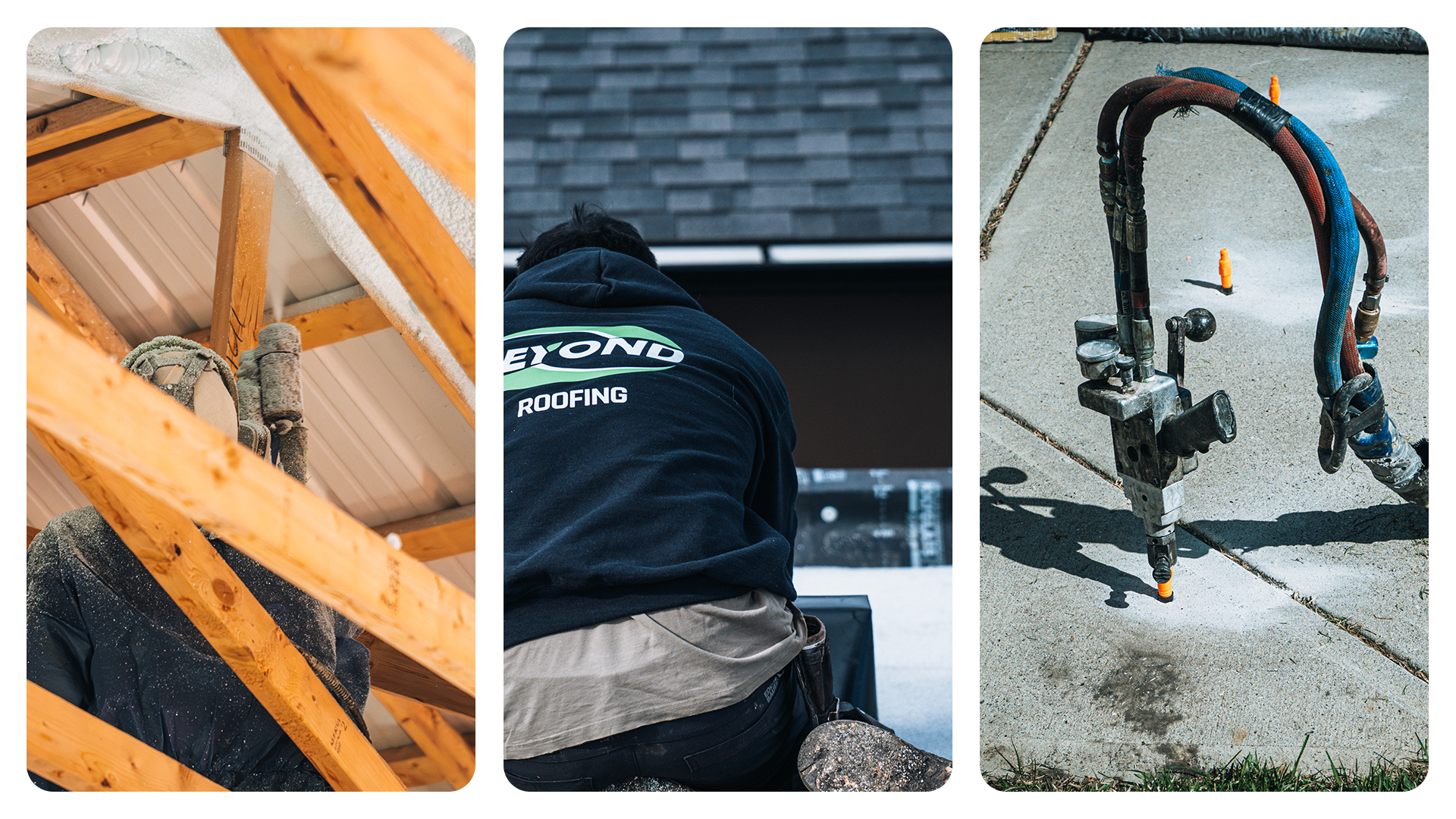
These are the best solutions we can offer within our residential services divisions: Insulation, Roofing, and Lifting. There are many variables in every job we take on, and we pride ourselves on working with clients to find the best solution for every need and every budget. When we say these are our “most trusted” solutions, we mean they are the best we have to offer, and not to toot our own horn (well, maybe a little bit), it’s what we’re best at.

"Having our client’s trust is something that Beyond Group takes seriously."

Most Trusted Attic Insulation Solutions

Insulating an attic can take on many forms. From traditional fiberglass loose fill to spray foam, and a myriad of others like mineral wool, hemp, or even aerogel.

Beyond Group got its start in spray foam, so we kind of like it a lot. But we’re not averse to other products because ultimately, the client’s needs are what matters the most.

When it comes to our most trusted insulation solution, we’ve found that a hybrid system of spray foam and fibreglass provides the best of both worlds: a great product and budget-friendly. Broken down, the hybrid system is two inches of spray foam installed on the attic floor, followed by a layer or two of blown in fiberglass.

The amazing thing about spray foam is that it also acts as an airtight vapour barrier, removing the need for a poly vapour barrier to be installed.

The foam keeps the cool unconditioned air where it’s supposed to be and maintains the heat inside your home. The fiberglass adds R-value to the system, making the bottom line on your energy bill a lot smaller. Some homeowners save between 15 and 22 per cent a month.

Spraying your attic with spray foam alone is an option and is great for spaces also used for storage. Unfortunately, this route can be well above budget for many people.

The return on the investment of using spray foam takes a little longer, but after a while, it pays for itself.

The Best Flat Roofing Systems We Installed in 2025 (And What They’re Best For)

Our number one product for flat and low slope roofs is the SPFRS (Sprayed Polyurethane Foam Roof System) - a spray foam roofing system that almost no one else installs in Alberta.

The SPFRS can’t be installed on any old roof; it needs to qualify, so we’ll get boots up on the surface to inspect at no charge to ensure the roof is a good candidate.

This fully renewable system uses 1.5 inches of closed-cell spray foam followed by two coats of silicone that’s embedded with ceramic granules. If the foam is protected, it will last forever, but the silicone and granules will need to be redone every few years to maintain that permanence.

The spray foam roof system is typically more affordable in the long run as the foam is permanent, and only updates on the top layers are required. This installation is also quicker than traditional roofing systems.

Our second-best roofing offering is a torch-on roofing system, or SBS (Styrene Butadiene-Styrene). Many other companies offer this type of roofing system, so it’s not uncommon to see it being installed on flat roofs.

SBS uses a base sheet put on top of the plywood or drywall, followed by cap sheet (also SBS that’s covered in ceramic granules), which is staggered over the base sheet seams. The two layers are “torched on” with either an actual torch or, more commonly, with flame-free devices that thermally fuse the two sheets together.

So, what is the appeal to doing spray foam versus the torch-on?

The appeal of installing the foam system versus the torch-on is the speed at which it can be installed, and the added R-value, which is R9, on top of the insulation product that is already in the attic. For example, an industrial bay that was built 30 years ago might only have an R20-rated roof.  Adding R9 to that will make a huge difference.

Older homes, such as a low-sloped bungalow, might have an R12 attic, and adding R9 to create an R21 will have a great impact on the homeowners' heating bills.

The actual cost of materials is relatively the same between SBS and SPFRS, but because the foam can be applied more quickly, the foam system is lower in labour costs.

Our crews can do 5,000 square feet in a day, whereas the torch-on achieves between 1,200 and 1,500 square feet a day.

We also work with other trades to ensure a proper, well-rounded job. In fact, we’re hoping to work with a trade partner in the new year to install a product called Euroshield, which is basically rubber shingles. While we wouldn’t be the ones installing the shingles, we will work on other aspects of the project, ensuring joint credit on a job well done.

Best Concrete Lifting Solutions in 2025 for Sunken Driveways, Sidewalks, and Other Concrete Slabs

Concrete lifting is more than just filling the void underneath a concrete slab and lifting it back to its original state. It’s a geotechnical solution that can last indefinitely and is a wise, economical choice before considering replacement.

When concrete settles, falls or cracks, it can cause all kinds of issues besides aesthetics. Not only can it result in trip hazards, but sloping towards a building foundation can promote water drainage against a home, leading to property damage.

Lifting concrete using polyurethane foam has become a passion for those in the division. This niche market was a natural progression from spray foam insulation that Beyond started with, as it’s the same infrastructure of equipment and similar polyurethane foams, just used in a different manner to help clients address their failing concrete issues.

The price of concrete isn’t cheap, so repairing a driveway or patio, for example, is a much more appealing project than replacing the entirety of the concrete slab.

Prior to concrete lifting, we had mud jacking. It’s a similar practice to what we can do with foam, but much more labour-intensive, and honestly, not as pretty when it’s done.

Mud jacking requires drilling holes in the concrete in many sizes from 1.5 to 2.5 inches in targeted locations and hydraulically pump a slurry cement mixture under a slab of concrete to fill the voids. However, the cored holes can become an eyesore afterwards due to their size.

Spray foam is an updated technology that doesn’t require large holes (only 5/8 of an inch, or the size of a dime) drilled into your concrete, and the finished look is more aesthetically pleasing. The added benefit of foam is that the material is more durable and lightweight than the slurry.

As mentioned before, the foam lasts a long time, several decades actually, not to mention it’s more environmentally friendly – the materials used become chemically inert, so it will not leach into the earth.

Another solution to void filling that we’re excited about is FillFoam - a pre-expanded, air-blown foam product that is pumped in at full volume. The foam hardens and strengthens when cured and produces zero heat as a by-product, so it’s ideal for filling voids of any size.

Traditional polyurethane foam for concrete lifting is created by combining two chemicals, causing a reaction of foam under the concrete, which expands and then lifts, whereas FillFoam becomes fully expanded above ground and is then pumped in and flows to fill a lot more of the voids below.

Fill Foam has only been in the market for about 5 years. and it's been a game changer for big, time-consuming projects that need to be ripped up and hauled away.

A couple of other benefits of FillFoam are that it is made of a combination of open and closed cell foam, so it has the ability to absorb, redistribute, and release water, and it has a life expectancy of 490 years!

FillFoam is not just used for concrete. It can be used to decommission mine shafts or pipelines, and fill void spaces of almost any size because it also doesn't produce heat when it's installed.

FillFoam can also be used in agriculture. Because it’s an organic material, FillFoam can be used to help promote the growth of plants. It’s rich in nitrogen and harmless to the environment, which means it can provide soil with nutrients and water better than soil alone.

FillFoam can absorb water, but it won't hold it and thus creates mold. It will soak up the water and then release it when the ground dries up, ebbing and flowing with the water tables under the ground.

Ready to Start? Let’s Talk It Through

If you’re considering a project and wondering what the right next step is, the best place to start is usually a conversation. Every situation is different, and there’s no one-size-fits-all solution, athough there may be a few like the above that are most common.

When you reach out to Beyond Group, you’re not committing to anything. We’ll ask questions, listen to understand your pain points, and be honest about what we think will work and what won’t. Sometimes that means confirming we’re a good fit. Other times it means pointing you in a different direction, and that’s okay too. Bottom line is, we want to make sure buyers are making informed decisions.

If you want advice from people who genuinely enjoy solving these kinds of problems, we’re always happy to talk.

You can call us at 403.730.8080 or email us a info@beyondgroup.ca.

back to stories