Breaking Down the Cost of Concrete Lifting

Jan 12, 2026
By
Jamie Unruh

There’s nothing more annoying as a homeowner than spotting a big issue that you know is either going to be a headache to deal with or a hit to your wallet.

Concrete is a material that can be finicky to work with and if not mixed correctly, it either looks like a toddler was playing in it or it needs to be redone a third or fourth time before you get it right which is a bigger pain in your pocketbook.

We chatted with Beyond’s Concrete Lifting Project Manager, Adam Dickinson to find out more about how to much it costs to repair a concrete problem.

When it comes to concrete lifting, no two jobs will be alike. There are many variables to consider, but we’ll do our best to examine the prices.

Before we get into that, let’s touch briefly on what is involved in concrete lifting. To put it plainly, when concrete is settling, a lifting specialist will determine the best place to drill a hole and fill it with expanding spray foam in order to level out the area.

Pricing a concrete job comes down to what the project requires in terms of volume of product. We can offer a price range for square feet, but generally there’s no flat rate per square foot, says Adam.

One of the first questions an estimator will ask is “How much foam material do we think is going to go into this project to get the result that we want?"

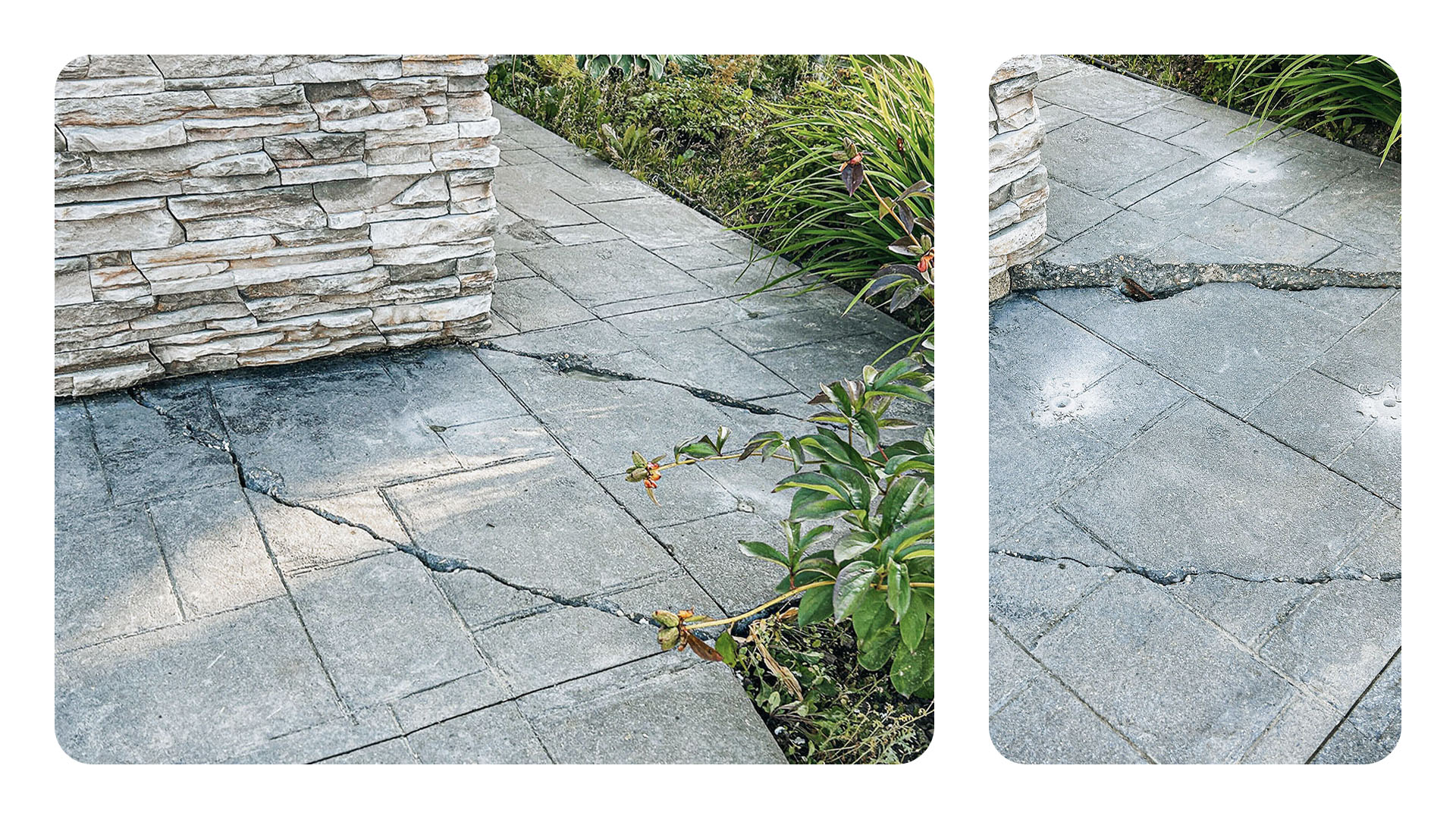
For better understanding, let’s use a common scenario of a settling driveway as an example. In most cases, the issue we see with driveways is within the approach to an attached garage which can create an array of different problems. Ground settling, slab pitching, joint splitting, backfill erosion, and developing a “lip” where the driveway meets the garage floor. These are all common issues that need concrete lifting to fix the problem.

"no two jobs will be alike"

Knowledge is Power, or a Good Path to an Appraisal

The most common concrete lifting repair takes place within the top 200square feet of driveway from where it meets the garage. Usually, it begins as visible cracking or even a rusty looking crack where the rebar is present. This can start with subtle pitching or lifting, creating a lip leading to the garage floor slab. Downspouts that are too close to the concrete can cause erosion in the backfill soil underneath the driveway which just speeds up the ground settlement.

This area is approximately 20 feet wide.

Measuring the affected area is the first step, starting with the slab itself from the top side, and we want to know where that point zero is, wherethe settlement started.

Figuring out where the settlement starts is often evident by cracks in the concrete sometimes coupled with hollow sounds when striking the top, whichcan mean there’s a void underneath.  That can also be denoted the joints splitting and opening up.

Once the dimensions of the affected area are known, estimators will ask several questions to ascertain the scope of the job, says Adam. Questions like: How and which direction is it settling? Towards the garage door? Is the whole thing broken apart and all four sides suck right to the ground? And by howmuch? Is it only settled in a quarter inch, or four inches?

“We need to know all these different things to really help us so we can understand how much material we think we're going to put into the project,” said Adam.

Even then, sometimes it becomes a bit of a guess. The voids underneath concrete slabs are sometimes hard to anticipate.

“Voids are typically two to three inches overall. That’s pretty common,” said Adam. “But the truth is, the kind of ugly beast of our industry, no matter what itis, you never know what's underneath concrete. There's always an element of you don't truly know unless you poke in there.”

With all the information gathered, an estimator will input it into a calculator with the sponsored inputs to help determine how many pounds of material the job will need, as well as the type of density of foam.

And from there, we have the foundation to build pricing on.

Per Square Feet, the Price of Concrete

Using square footage as a measurement is a more common way to offer pricing, but because of the variables involving concrete, all prices will be in a range. An actual quote would be more specific.

Using the driveway example from before, if point zero is cracked about10 feet back with one side of the slab dropping down and requiring just one side to be lifted, that’s called a one-sided lift.

If the slab settles more toward one corner, it’s a two-sided lift. From a geometrical standpoint, a two-sided lift will require more material than a one-sided lift.

Another factor to consider is the load the expanding foam will take on when it’s pumped into a confined space.

The more the concrete slab weighs, or the more weight it bears (i.e. adetached garage structure), more foam is needed to make the area level.  

Now, if the concrete pad is found to be a one-sided lift, based on lifting it one inch will range roughly $3.90 to$7.80 per square foot. So, an approximate average of $5.80.

Lifting two inches will cost between $6.50 and $13 per square foot. About $9.75 average.

More severe settlements such as three inches or more can be as much as $9to $18 per square foot - $13.60 on average.

When it’s no longer ideal to just fix the concrete lift and it comes to having to replace it all together, the cost ranges from $15 to likely well above $20 per square foot.

Non-concrete Factors That Affect Pricing

Outside of the site conditions, there are three other factors that can affect the price of concrete lifting.

First, is inflation. When the economy is in the dumps, the price of raw materials and how they're sourced will affect the bottom line.

Second is the price of oil and gas. When the cost of oil and gas is high, the cost to operate factories to produce goods and services or just run vehicles goes up, and it all trickles down to the consumer.

The third factor is the supply chain. This is the procedure of creating something from raw material to the finished product, and if one part of this complex framework is out of whack, then the entire system is affected.

Maybe less common, but still a potential factor to affect costs is Mother Nature. Concrete lifting is ideal in warmer months, but it is possible to do it in the winter months depending on the conditions.

A concrete floor surrounded by foundation walls, such as a garage or basement floors   that are not affected by the weather or ground frost is totally feasible to repair.

For commercial floors in warehouses, winter is the perfect time to do repairs.

However, exterior jobs such as driveways, walkways and patios are not ideal for the obvious reason that is ground frost.

Concrete cracks a lot easier when it's cold, and frozen ground can cause the concrete to bind or not lift in an optimal way. If concrete is raised on frozen ground, it can also allow for quicker settlement in the spring when the ground thaws.

The cold can also really mess with the equipment and foam reaction.

“It all kind of boils down to quality... because when you're installing foam into a frigid environment, those ambient cold conditions can slow down the reaction of the foam, and it can decrease the yield,” said Adam.

Whatever your concrete project may be, Beyond Group is happy to discuss solutions that can make your wonky drive, pathway straight again.

“It all kind of boils down to quality"

back to stories