

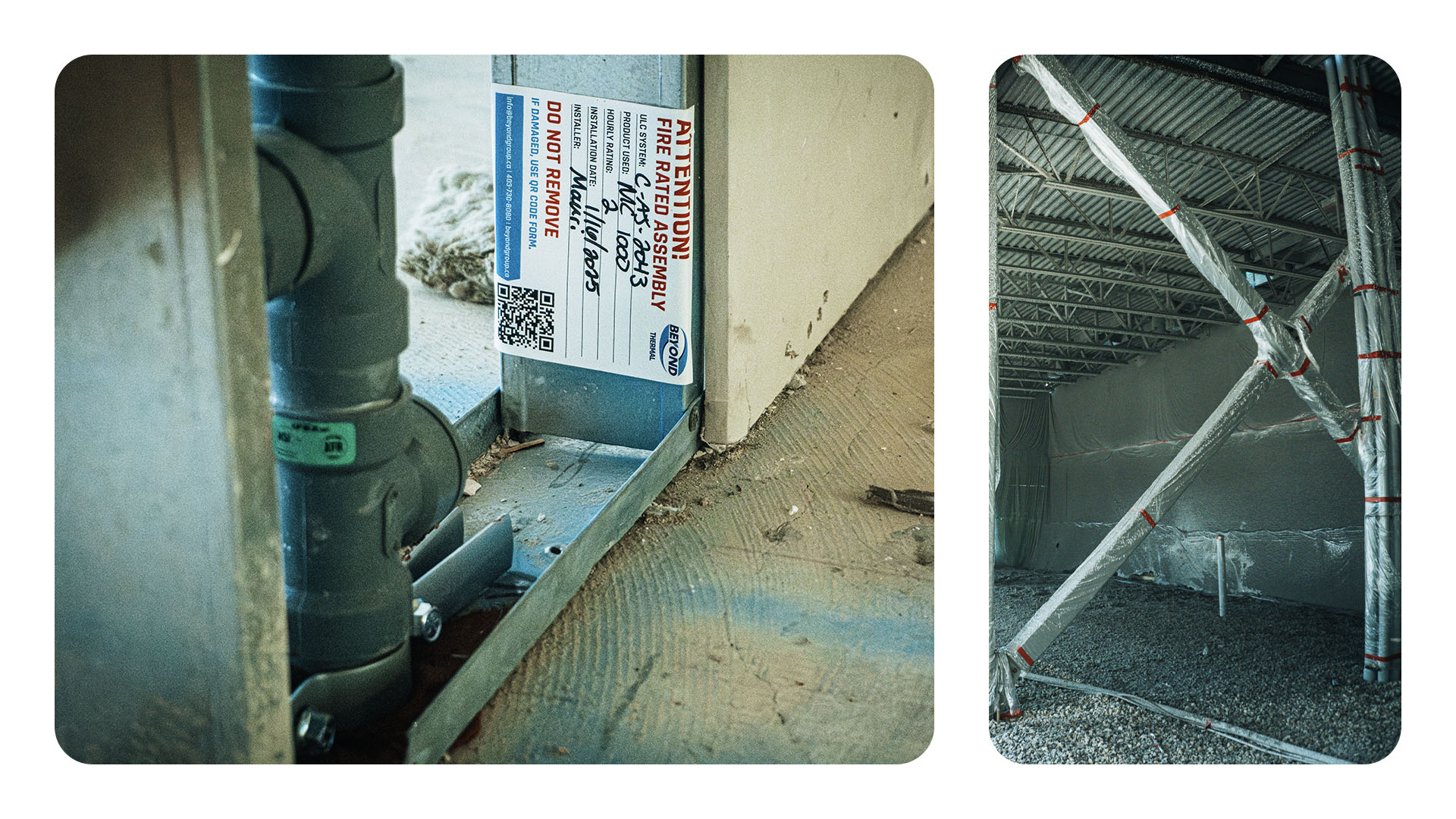
Installing fireproofing or firestopping safeguards in a building can save lives. Protecting a structure from the damaging effects of a fire is a very important application for commercial construction today. There is a myriad of different fireproofing and firestopping products that can be used in various locations of a building depending on what type of safeguards the building requires.
Fireproofing and firestopping are both forms of passive fire protection, which means they work to protect the integrity of a building by keeping the fire in one area. Active fire protection is provisions such as alarms and sprinklers.
Firestopping is a collection of materials used together in a specific way (with full instructions) to keep fire and smoke from travelling through any gaps and spreading across a building.
The combination of these materials is what makes up the firestopping system.
Both fireproofing and firestopping installations require tested and listed UL, ULC, and FM systems (Underwriters Laboratories, Underwriters Laboratories Canada which are safety certification organizations that test and certify products for safety standards and Factory Mutual which is a global insurance company that also conducts testing and certification).
These tested and listed systems work to maintain the fire resistance rating of the floors and walls that are being installed onto with the use of specialized products.
Both firestopping and fireproofing provide two different life safety jobs. Firestopping is about compartmentalization – keeping the fire contained in one area, and fireproofing is about protecting the building’s structure – ensuring the occupants can vacate before the structural integrity is compromised.
But let’s dig a little deeper into what each of these types of system designs are used for.
"protect the integrity of a building by keeping the fire in one area."
