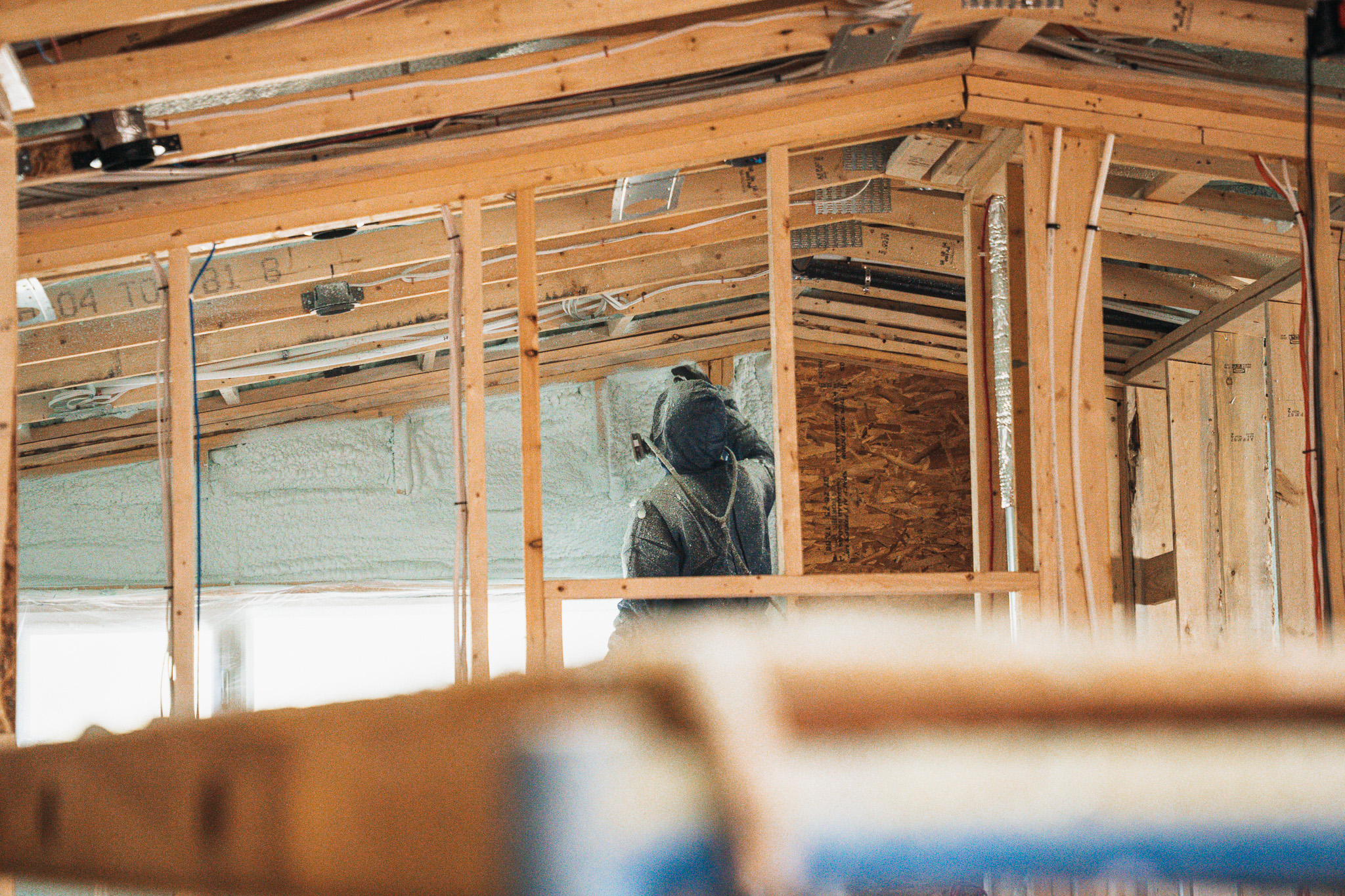
Myth #1: Spray Foam is Toxic
It’s important to note that when spray foam is being installed there are two very different occurrences regarding the air that are happening: atomization and off gassing.
The toxicity of spray foam is often overexaggerated because there is confusion between the two different reactions. Off gassing does happen, but it’s minute, certainly less than other plastics that are in your home.
At Beyond, we're less concerned about off gassing and more concerned about the atomization that develops when the foam is being sprayed.
The atomization of the raw liquid product is actually the dangerous part.
Because it’s a pressurized system, the two liquids (isocyanate and polyol resin) being mixed will naturally atomize into the air as a mist. That mist becomes breathable and that’s not a good thing.
Isocyanate reacts with water and crystalizes, and humans being made of 60-70% water makes for a bad combination. That’s why our crews wear personal protective equipment (PPE) during the installation and why we ask homeowners to leave the premises during the project.
Off gassing occurs after the foam has been sprayed and while the foam is curing, it’s no more dangerous than the off gassing of plastics on a new toy. We encourage homeowners to vacate their homes for 24because we want to go above and beyond the standard safety measures that manufacturers require. More on that later.
When it comes to off gassing, our Technical Data Sheet (TDS) doesn’t provide the number because it’s so small the instruments used to detect any danger can’t measure it.
The finished foam product is inert. In fact, some employees joke that you can eat it! Obviously, we don’t recommend sneaking a taste, it is still plastic after all, but it goes to show that spray foam is really quite safe.
To summarize, the foam itself is not dangerous, the raw products that we use to create the foam are dangerous, which is why you want to make sure that you have a trained professional and a very experienced company doing the work.
Myth #2: Spray Foam is the New Asbestos
Due to the myth that spray foam is toxic, it has been said that foam is the new asbestos and that in due time spray foam will also be banned as a construction product.
Well, that’s simply not true. Spray foam has been around for decades. It’s been used in homes for the better part of 30 years. It’s been used in the automotive industry, in furniture, and even in space rocketry!
A NASA space shuttle’s external fuel tank was fully spray foamed(the orange colour came from the foam reacting to UV light) to insulate and maintain optimal low temperatures during launch.
The myth that spray foam could be the new asbestos might come from the fact that the foam used to contain formaldehyde. This type of foam was used in houses in the 1950s and 60s, so when crews come across old foam like this, which is not often, it is treated as asbestos, and they will call on our friends at Wise Abatement to remove it as a precaution.
Formaldehyde foam isn’t common. At Beyond we’ve seen it very few times and as such was in a very small area.