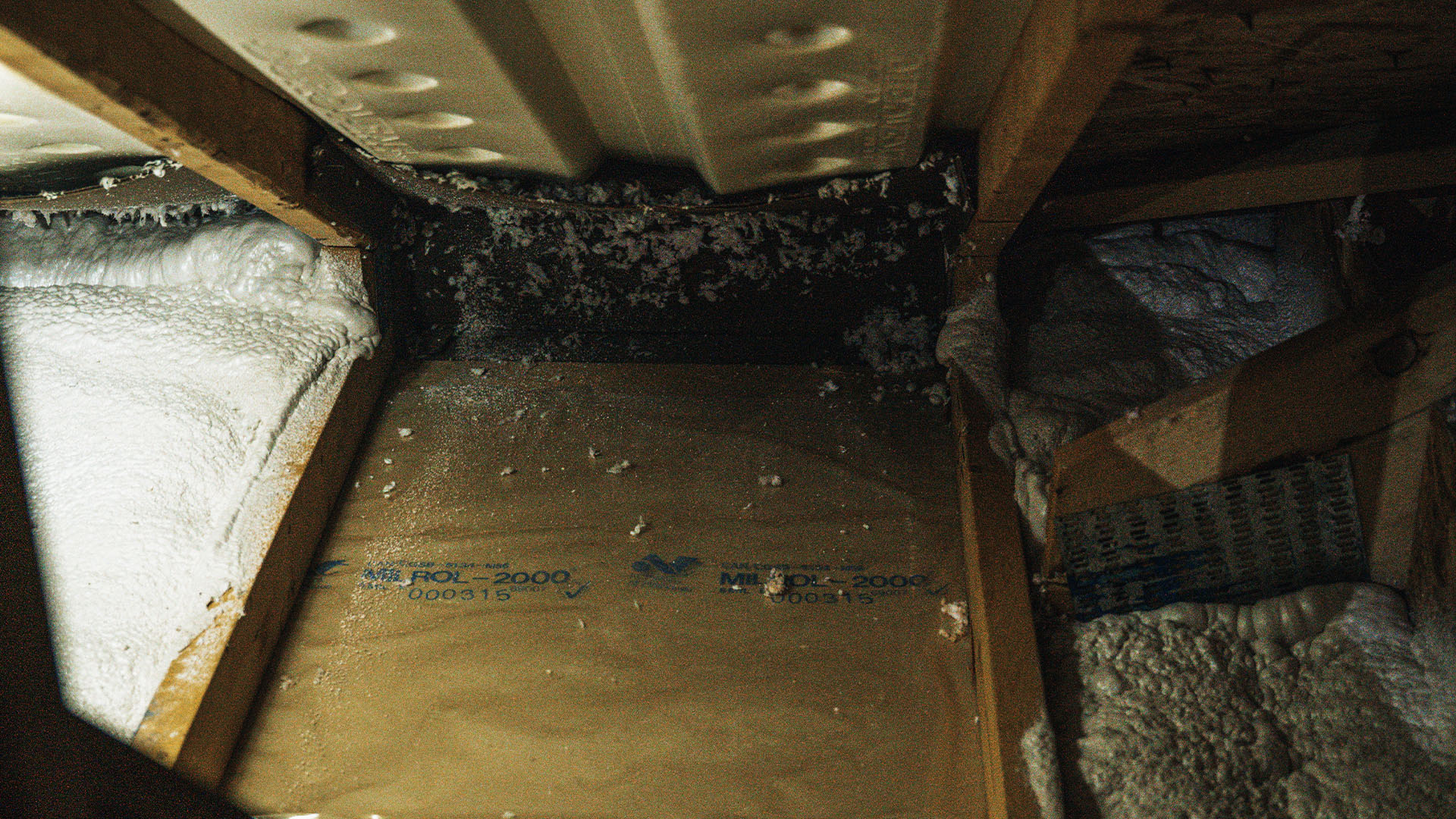
Vapor Barrier
Insulation is only as good as how air tight it is, and a vapor barrier is essential to prevent air from moving where you don’t want it to.
A quick pop into an attic will prove there’s insulation, but it is more than just the material used to insulate. It’s a whole assembly, and the vapor barrier plays an extremely important part. Some older homes don’t have a vapor barrier as it wasn’t always required by the building code to install one.
In a cold climate like ours in Calgary, you can’t skimp on the vapor barrier because that's what is physically going to stop air movement. It’s what separates the warm humid air being pushed through the house through the furnace and the cold exterior air. Without a very well air-sealed vapor barrier, you're going to lose air to the other side of the insulation.
At Beyond, we recommend 6mil polyethylene (this is not a millimeter measurement, but means the poly is 6 millionths of an inch thick) that is sealed with an acoustical sealant and blue tuck tape.
Both the vapor barrier and insulation work together to create a comfortable and energy efficient home.
Not Enough Insulating Material
So, there’s an airtight vapor barrier and a bunch of insulation in your attic, but the house is still cold. It could be that there’s just not enough of the insulating material to keep the heat in.
An R-value is the measure of thermal resistance of an insulating material which tells how well the heat is kept in or out of a building – the higher the number, the better the insulation is working.
The R-value of an insulating material works on a per inch of product. Different types of insulation have different R-Values. For example, the most common type of insulation, fiberglass, is rated at 3.2 per inch, so a few inches of it won’t be enough in a ceiling to keep a house warm.
An R50 or 60 rating from insulation in a ceiling is a nice number to keep your home comfortable, but most homes are found to be around R20 or 30,again, not enough to warm up your home.
Checking the depth of the fiberglass insulation in a ceiling is a good way to determine if you might need more. Typically, less than 14 inches is a sign you’re due for a top up.
Cellulose insulation is quite dense, so it settles and gets compacted over time, therefore it will need to be topped up to ensure it’s doing a proper job.
Insulation is only as good as the heat or cold that you're putting into it. A detached garage, for example, can be fully insulated but without a heater, it will just trap the cold air inside.