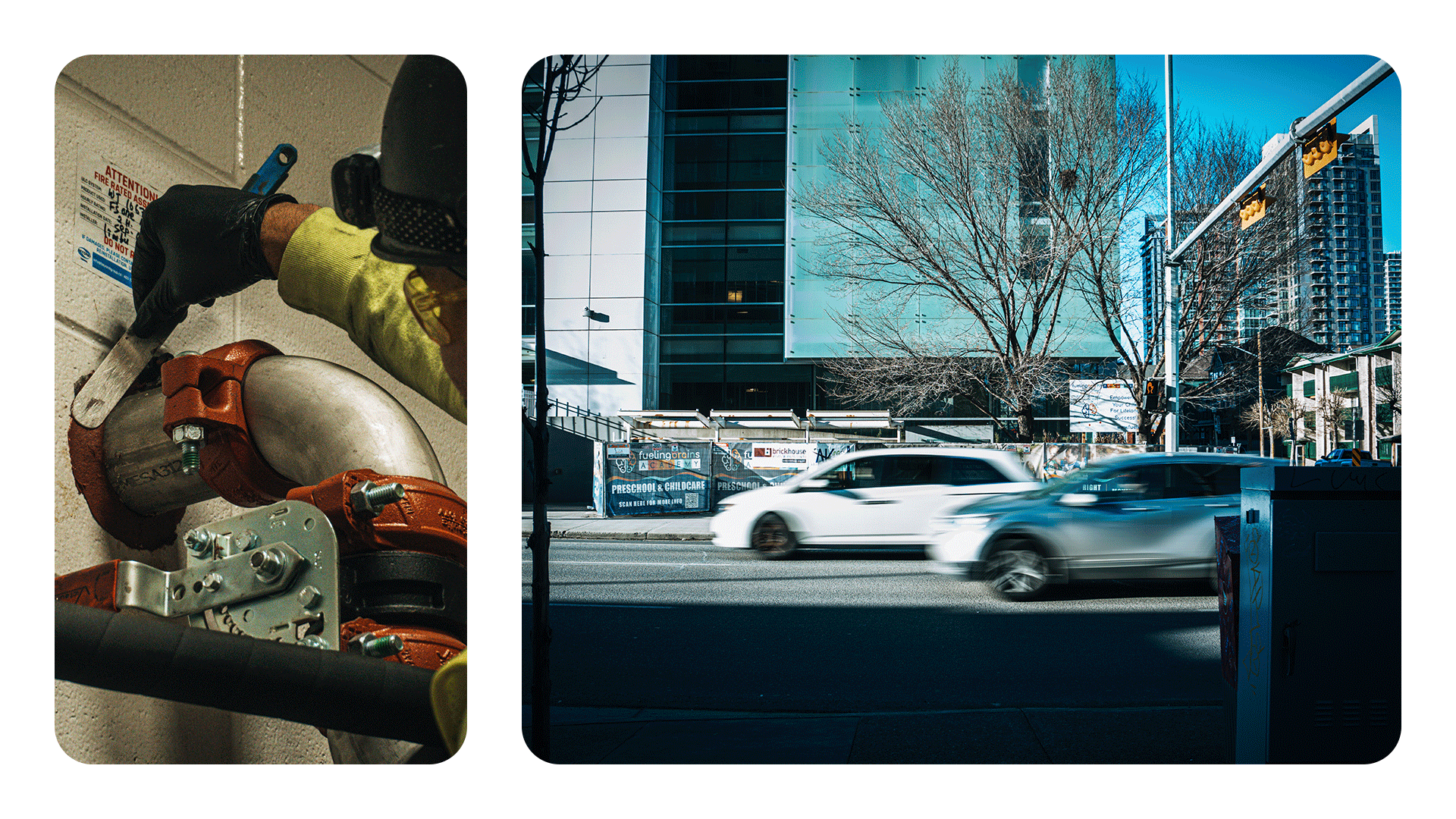
Firestop 101

Feb 17, 2026
By
Jamie Unruh

There are many facets to Beyond Group, and this scribe has been learning a lot about all the different divisions.

Firestopping is one such industry I had never heard about. I learned about the difference between firestopping and fireproofing, but I realized there is just so much more to the former that I should dig a little deeper.

Thanks to Beyond’s Firestopping Project Manager, Corey Beckett, I was hooked up with an introductory course on the topic through the Firestop Contractors International Association (FCIA), and I’m now about to educate you, too!

Passive vs. Active Fire Protection

When it comes to fire protection, there’s active fire protection which includes sprinklers and alarm systems.

Then there’s passive fire protection which is more about the components of a building to stop the spread of fire. Put another way, it’s the protection of the structure to prevent collapse, and effective compartmentation that keeps fire from spreading from one area to another which provides people with the safety they need to get out of the building.

Together they protect the integrity of a building but above all, they can save people’s lives should a fire take place.

Passive fire protection has been around for centuries. After a huge blaze destroyed over half of ancient Rome, Emperor Nero established new rules to prevent future disasters. These rules included using non-combustible materials for new builds and engineering buildings with larger distances between them to slow the spread of fire.

After another famous inferno, the Great Fire of London, new buildings were required to be built with stone or brick, and new regulations came about to prevent overcrowding in homes.

Since then, passive fire protection has only gotten better. And today we have entire systems using various firestopping materials that have proven to protect buildings and the people inside them.

Detection, suppression, and compartmentation are three key fire protection layers that work together to protect building occupants. Detection such as fire alarms and smoke detectors provides early warning. Suppression, such as water sprinklers, helps control the fire at or near the point of origin. Compartmentation, which is a form of passive fire protection, uses fire-resistance-rated walls and floors, protected openings, and firestopping to limit the spread of fire and smoke and maintain safe conditions for evacuation.

What is a Firestopping System?

Wherever there's a breach or a gap in a fire-rated wall or floor, that hole must be sealed using a tested and listed firestop system.

According to the FCIA, a firestopping system is an assemblage of materials used as a system installed in accordance with the manufacturer's instructions, to stop the spread of smoke and fire from one area of a building to another. Say what?!

In other words, it’s a collection of materials used together in a specific way (with full instructions) to keep fire and smoke from travelling through any gaps and spreading across a building.

The combination of these materials is what makes up the firestopping system.

These systems are tested by a third-party laboratory to properly test standards by which the firestopping system is held. If one of these systems fails, the whole thing fails and then you are risking people’s lives, or their assets.

These standards provide a detailed outline (called a tested and listed system) on how these products must be installed.

Compartmentation is Key

Firestopping starts with the design of the building.  Architects will provide drawings that include the location of life safety fire-resistant walls and floors.

With these plans, firestop installers can correctly identify what areas need to be sealed and with what type of infrastructure system or material is required.

Fire-rated floors and walls are designed, tested, and built to stop the spread of smoke and fire, but if there's a breach in a wall or floor, you lose the fire rating of that assembly.  Firestopping is accomplished by compartmentalization of those floor and wall assemblies.

Effective compartmentation slows the fire or stops it, so the compartments stay safe. Compartments can be rooms, hallways, or corridors that lead to a safety spot outside a structure or another part of the building.

Firestopping not only keeps fire to one area, but it’s also used to keep smoke from spreading too. Smoke can move quickly and can be just as lethal as fire, so it’s important that firestopping is installed correctly.

"Smoke can move quickly and can be just as lethal as fire"

What are Firestopping Products and How Do They Work?

Because every job will have a variety of utilities in different spots, every situation will require a thorough inspection to determine which system and what specific materials will be needed to secure the openings.

Firestopping materials come in all shapes, sizes, and forms. There’s, packing material, firestop sealant, firestop foams, firestop spray, firestopping mortar, wrap strips and collars, premanufactured sleeves, cast-in-place devices, intumescent pillows, foam blocks, composite sheets, firestop tape, firestop putty, and more.

All of these products are used to protect the breach where pipes or wires and the like have penetrated a fire rated wall or floor.

The fire stopping protects the opening and extends the fire resistance rating of the wall or floor to make sure that the assembly is protected, and the continuity of the fire separation is maintained.

Many of the materials used in a firestop system have intumescent or swelling agents added. These products are designed to expand when it's heated, which allows it to fill the void.

There are also endothermic products which have moisture in them that slow down the erosion of the product when it’s exposed to fire.

Elastomeric materials are designed to stretch in the opening which allows for movement of the penetrating item or the joint. There are two types of elastomeric materials, endothermic which uses moisture as outlined above, orablative (no, that’s not a spelling error, it’s a real word) which creates its own char to slow down the spread of fire.

As you can tell, there are many different types of materials that can be used to build a firestop system, and that’s where the tested and listed systems come in.

A firestop system will have a main manufacturer listed with their product as a major piece of that firestop system. It’s like a set of instructions for how to install a certain material in a specific situation, whether it be sealing a metal pipe in a ceiling or a wire box in a wall.

Why Is Firestopping Important?

Firestopping is a life safety issue. It keeps people in areas of a building safe, especially in buildings that house many people.

Hospitals, nursing homes, prisons, hotels, or apartments, all use a “defend in place” strategy that protects people in those buildings. Typically, it’s used in places where people can’t move quickly or are detained, so those in danger are moved to safe areas rather than out of the building. These safe areas are “defended” with fire and smoke barriers, or firestopping.

Compartmentation plays a big role in this type of situation. Having fire separation will keep people safe and allow firefighters time to evacuate people out of a building safely.

There is so much more to this subject, but I think I’ll stop there. Pun intended.

When it comes to firestopping, the value of human life scores above all the technical aspects. Those who install firestopping measures take pride in their work knowing that there’s the lifesaving potential one day, and really what’s more rewarding than that?

There’s a lot to understand about how and why firestopping works and is needed. At Beyond Group we have a whole team dedicated to this work, and they’re happy to chat about the ins and outs of your firestopping needs. Give us a call today! (403) 730-8080

"Firestopping is a life safety issue"

back to stories